You Gotta See These Amsterdam Icons — My Must-Visit Buildings That Stole the Show
Amsterdam isn’t just canals and bikes — it’s a city where every building tells a story. From historic facades leaning like sleepy giants to sleek modern masterpieces rising along the water, the architecture here is alive. I walked the streets with my eyes upward, stunned by how old and new coexist so effortlessly. These landmark buildings aren’t just postcard sights — they’re the soul of the city. They reflect centuries of resilience, creativity, and cultural evolution, standing as silent witnesses to trade booms, royal ceremonies, artistic revolutions, and everyday life along winding waterways. To truly know Amsterdam, you must look beyond the surface and see the stories etched in brick, timber, and glass.
The Architectural Heartbeat of Amsterdam
Amsterdam’s cityscape is a living timeline, each building a chapter in a long and vibrant narrative. Unlike cities that erased the past for modern development, Amsterdam has preserved its architectural heritage while embracing innovation. The result is a rare harmony between centuries-old gabled houses and bold contemporary designs. This balance didn’t happen by accident — it emerged from a deep respect for history, a commitment to urban livability, and a culture that values both function and beauty. The city’s compact layout, crisscrossed by over 100 canals and 1,500 bridges, creates intimate streetscapes where every structure feels intentional.
What makes Amsterdam’s architecture so compelling is not just its visual charm but its layered meaning. A narrow house on a canal may seem quaint, but it once reflected inheritance laws or fire safety measures. A grand warehouse turned museum once stored spices from distant colonies, fueling the city’s Golden Age. Even the tilt of a 17th-century merchant’s home — often leaning forward to hoist goods without damaging the facade — reveals practical ingenuity. These details turn a casual walk into a journey through time.
For visitors, especially those who appreciate history, design, and quiet beauty, Amsterdam offers more than picturesque views. It invites reflection on how cities evolve without losing their identity. The buildings here are not museum pieces frozen in time; they are adapted, reused, and reimagined. Homes become galleries, churches host concerts, and industrial towers transform into cultural hubs. This spirit of reinvention ensures that Amsterdam remains dynamic, welcoming, and deeply human in scale.
The Royal Palace on Dam Square: Power in Stone and Wood
Rising with quiet authority at the heart of Dam Square, the Royal Palace stands as one of Amsterdam’s most commanding landmarks. Originally built as the City Hall during the Dutch Golden Age in the 17th century, it was a bold declaration of civic pride and wealth. Designed by architect Jacob van Campen, the building embodies classical ideals — symmetry, proportion, and grandeur — drawing inspiration from ancient Rome. Its massive sandstone façade, adorned with sculpted figures representing justice, trade, and wisdom, speaks to the values of a republic at the height of its power.
Beneath its elegant exterior lies an engineering marvel: the palace rests on more than 13,000 wooden piles driven deep into the soft soil. These oak beams, preserved by the waterlogged ground, have held the structure steady for over 350 years. This foundation is a testament to Amsterdam’s ingenuity in building on unstable terrain — a challenge the city has mastered since its earliest days. While the palace now serves as a royal residence used for state visits and ceremonies, it remains open to the public during parts of the year, allowing visitors to walk through its opulent halls.
Inside, the central hall — once the city’s courtroom — soars with marble columns, intricate carvings, and a ceiling painted by Ferdinand Bol, a student of Rembrandt. The space was designed to impress, and it still does. Citizens once came here to settle disputes; today, dignitaries arrive for diplomatic receptions. This transformation mirrors Amsterdam’s own journey — from a powerful merchant republic to a modern constitutional monarchy within the Kingdom of the Netherlands. The Royal Palace is not just a relic of the past; it is a living symbol of continuity and adaptation.
For the thoughtful traveler, standing in the shadow of the palace offers more than photo opportunities. It provides perspective on how civic institutions once shaped urban identity and how architecture can carry meaning across generations. Whether admired from the square or explored within, the Royal Palace reminds us that power, when expressed through design, can inspire reverence without intimidation.
The Skinny House: A Quirky Survivor on Herengracht
Along the elegant curve of Herengracht, where grand canal houses with ornate step-gables line the water, one building stands out for its sheer narrowness. Known affectionately as the Skinny House, or *Het Smalste Huis van Amsterdam*, this slender structure measures just over 2 meters wide at its base. At first glance, it looks like a whimsical illusion — a child’s dollhouse slipped between two stately mansions. But this tiny home is real, inhabited, and rich with history.
The exact origins of the Skinny House remain a bit of a mystery, but local accounts suggest it was built in the 17th century, possibly as a firebreak between properties or as a result of inheritance division. In those days, property taxes were based on street frontage, so some owners constructed narrow homes to minimize costs while retaining ownership of their land. Others believe it was a builder’s act of spite — a way to block a neighbor’s view. Whatever the reason, the house survived centuries of urban change, fires, and redevelopment, becoming one of Amsterdam’s most beloved architectural curiosities.
Despite its size, the house is fully functional, with multiple floors connected by steep stairs. It once served as a residence and later as an office. Today, it stands as a private home, its bright red door and flower-filled window boxes adding charm to the canal scene. Its survival is a quiet triumph of resilience — a reminder that even the smallest spaces can hold significance. Tourists often stop to take photos, marveling at how anyone could live there, but for Amsterdammers, it represents the city’s creative use of limited space and its tolerance for eccentricity.
The Skinny House also highlights the contrast between wealth and ingenuity in Amsterdam’s urban fabric. While the surrounding mansions were built by wealthy merchants to display their success, this tiny structure tells a different story — one of practicality, humor, and persistence. It shows that architecture isn’t only about grandeur; sometimes, it’s about making the most of what you have. In a city where space is still at a premium, the Skinny House remains a symbol of clever urban living.
A’DAM Tower: Modern Heights with a View
Just across the IJ River from central Amsterdam, the A’DAM Tower rises like a beacon of modernity. Once a utilitarian office building for energy companies, it has been transformed into a vibrant cultural and tourist destination known as A’DAM Lookout. This sleek, cylindrical tower offers one of the best panoramic views in the city, stretching from the historic center to the distant dunes. At 100 meters tall, it provides a striking contrast to Amsterdam’s traditionally low skyline, where few buildings exceed church spires in height.
The Lookout’s most famous feature is the “Over the Edge” swing — a heart-racing pendulum ride that propels riders in a full 360-degree loop over the edge of the tower. While not for the faint of heart, it has become a signature experience for adventurous visitors. More than just a thrill, it symbolizes the city’s willingness to embrace bold ideas and new forms of engagement. Below the observation deck, the tower houses a music studio, event spaces, and a rooftop bar where locals gather at sunset, drawn by the view and the lively atmosphere.
What makes the A’DAM Tower significant is not just its height or attractions, but its role in the redevelopment of Amsterdam’s northern bank. Once an industrial zone, this area has been revitalized into a hub for creativity and innovation. The tower anchors this transformation, offering a modern counterpoint to the historic center. It reflects a city that honors its past while confidently building for the future. For families, couples, and solo travelers alike, a visit here offers a different perspective — literally and figuratively — on what Amsterdam has become.
From the top, you can trace the arc of the canals, spot the distinctive spire of the Westerkerk, and see how the city blends dense urban life with green parks and open water. It’s a view that invites reflection on Amsterdam’s growth, resilience, and balance between tradition and progress. The A’DAM Tower doesn’t overshadow the old city; it complements it, reminding us that a city’s identity can expand without losing its soul.
Westerkerk: The Church That Rang Through History
Dominating the skyline of the Jordaan district, the Westerkerk, or West Church, is the tallest church tower in Amsterdam, standing at 85 meters. Completed in 1631, it was one of the first buildings constructed outside the medieval city walls, marking the city’s expansion during the Golden Age. Its Renaissance-style tower, crowned with a distinctive spire and weather vane, has guided sailors, inspired artists, and called citizens to worship for nearly four centuries.
The Westerkerk is more than an architectural gem; it is woven into the city’s emotional and historical fabric. Perhaps its most poignant connection is to Anne Frank, who, while hiding in a secret annex nearby, listened to its chimes and mentioned the tower in her diary. Today, visitors can climb the 170 steps to the top, emerging into a small platform surrounded by bells. From here, the view encompasses rooftops, canals, and the ever-present waterways that define Amsterdam’s layout. The sound of the carillon — played live by a tower musician several times a week — drifts across the neighborhood, a living tradition that continues to mark the passage of time.
The church itself remains an active place of worship, but it also hosts concerts, lectures, and community events, ensuring its relevance in modern life. Its interior, though simpler than some grand European cathedrals, exudes warmth and solemnity, with wooden pews, stained glass, and a sense of quiet dignity. The Westerkerk represents how religious architecture, even in a secular age, can serve as a cultural anchor — a place of reflection, music, and shared memory.
For many, hearing the bells of the Westerkerk evokes a deep sense of place. It’s a sound that has accompanied births, weddings, and farewells, echoing over the same streets for generations. In a city that changes quickly, the church stands as a constant, its presence a comfort. It reminds us that some structures do more than occupy space — they hold time, memory, and meaning.
The Eye of the Future: EYE Filmmuseum’s Bold Design
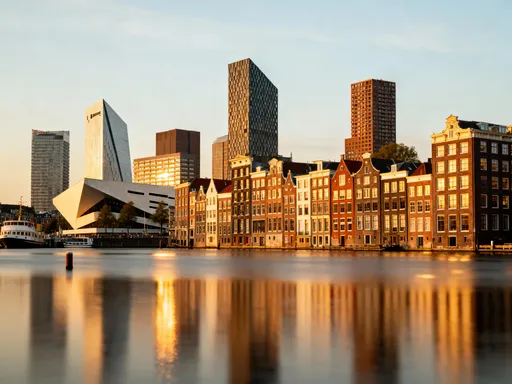
On the northern shore of the IJ River, the EYE Filmmuseum bursts onto the skyline like a cinematic vision made real. Its striking red structure, composed of sweeping curves and sharp angles, juts out into the water as if reaching toward the city. Designed by Dutch firm Delugan Meissl Associated Architects, the building is a masterpiece of contemporary design, intended to evoke the motion of film and the glow of a projector. At night, illuminated from within, it glows like a lantern, visible from across the water.
The EYE Filmmuseum is dedicated to the art and history of cinema, housing one of Europe’s largest film archives. Inside, spacious halls filled with natural light guide visitors through rotating exhibitions on directors, genres, and technological innovations. Interactive displays allow guests to step into film scenes, experiment with editing, or watch classic movies in intimate screening rooms. The museum doesn’t just preserve film — it celebrates it as a living, evolving art form.
What makes the EYE Filmmuseum special is how its architecture enhances the experience. The building itself feels like part of the exhibition — dynamic, forward-looking, and immersive. Wide terraces offer unobstructed views of Amsterdam’s skyline, making it a favorite spot for photographers and couples alike. A ferry from Central Station takes visitors across the water in just a few minutes, turning the journey into part of the adventure.
For families, the museum offers child-friendly programs and workshops that introduce young audiences to storytelling through film. For film lovers, it’s a pilgrimage site. And for casual visitors, it’s a reminder that culture can be both serious and joyful. The EYE Filmmuseum shows how bold architecture, when paired with a clear mission, can create spaces that inspire curiosity and connection. It stands not in opposition to Amsterdam’s historic buildings, but in dialogue with them — a modern voice in an ongoing conversation about art, memory, and imagination.
Practical Tips: Navigating Amsterdam’s Architectural Gems
Exploring Amsterdam’s architectural treasures is a delight, but a little planning can make the experience even more rewarding. The city is compact and walkable, so the best way to appreciate its buildings is on foot. Start early in the morning to avoid crowds and catch the soft light that makes canals and facades glow. A self-guided walking route connecting Dam Square, the Royal Palace, the narrow streets of the Jordaan, and the Westerkerk allows you to see centuries of design in just a few hours.
For a different perspective, take a canal boat tour — especially one that runs during twilight, when the city lights reflect on the water. Many operators offer informative commentary in English, highlighting architectural details you might miss from the street. Be respectful of private homes; while it’s tempting to photograph every gable and window box, avoid peering into windows or disturbing residents. Most canal houses are still private residences, and their owners value their privacy.
When visiting major sites like the Royal Palace or the A’DAM Tower, check opening times in advance, as they can vary by season. The A’DAM Lookout is best visited in the late afternoon to enjoy both daylight views and the evening skyline. For the Westerkerk tower climb, wear comfortable shoes — the stairs are narrow and steep. Photography is generally allowed in public areas, but flash and tripods may be restricted in museums and churches.
Public transportation is efficient and easy to use. Trams, buses, and ferries connect key sites, with the free ferry to the EYE Filmmuseum being a highlight. Cycling is popular, but if you’re unfamiliar with Amsterdam’s bike traffic, it’s safer to walk or take transit. Combine sightseeing with breaks at local cafes — try a stroopwafel with coffee at a canal-side koffiehuis or a simple lunch at a brown café with wooden beams and cozy charm.
Accessibility varies. The Royal Palace and EYE Filmmuseum are fully accessible, with elevators and facilities for visitors with mobility needs. The Westerkerk tower climb is not suitable for those with limited mobility, but the church itself is accessible. The Skinny House is viewable from the outside only. Always check official websites for the latest information on access, tickets, and special events.
Buildings That Breathe Amsterdam’s Soul
Amsterdam’s architecture is more than a collection of beautiful buildings — it is the city’s living memory. Each structure, whether towering or tiny, grand or modest, carries stories of people who built, lived, worked, and dreamed within its walls. From the Royal Palace’s marble halls to the Skinny House’s clever compactness, from the Westerkerk’s ringing bells to the EYE Filmmuseum’s cinematic glow, these landmarks form a tapestry of time, resilience, and creativity.
They remind us that cities are not just places we visit, but experiences we feel. To walk through Amsterdam is to move through layers of history, where every corner offers a new detail — a carved stone, a leaning beam, a burst of color in a window box. These elements, small and large, combine to create a sense of belonging, of continuity, of human effort shaping the environment.
For the traveler, especially one who values depth over speed, Amsterdam invites a slower way of seeing. Look up. Pause. Notice how the light hits a gable at dusk, how a church spire pierces the clouds, how a modern tower reflects the water. These moments of observation connect us to the city’s rhythm, to the lives that came before, and to the future still being built.
Amsterdam does not shout its wonders — it whispers them. Its beauty is in the details, its strength in its quiet endurance. And as you stand on a bridge, watching boats glide beneath, you realize that this city, built on water and wood, stands not despite its fragility, but because of the care and vision that have sustained it for centuries. These buildings are not just landmarks — they are keepers of a story, and now, you’ve become part of it.